
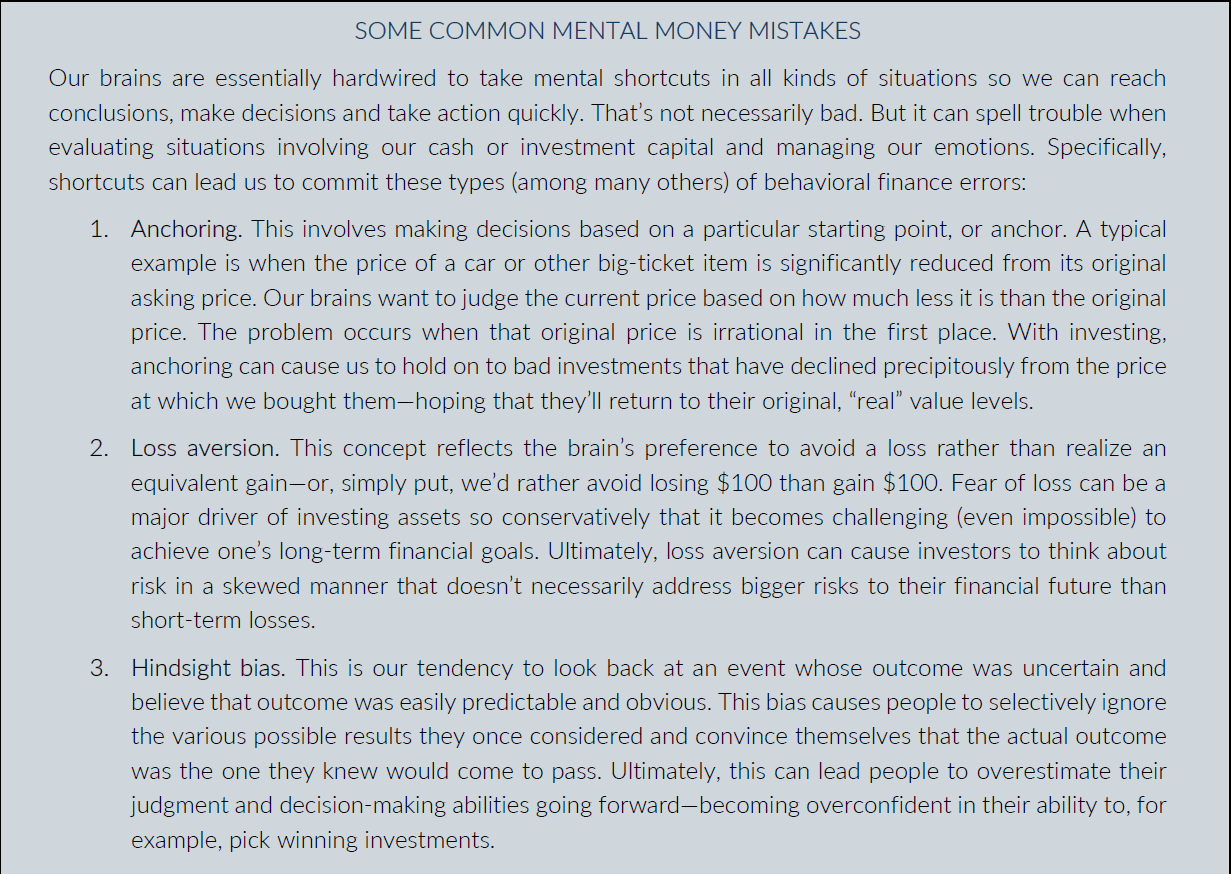
Behavioral finance—the study of people’s biases about money and investing, and how those biases impact decision making—has become a hot topic. A pioneer in the field even was awarded the Nobel Memorial Prize in Economic Sciences for his work a few years ago.
Understanding some key aspects of behavioral finance can potentially help you make smarter decisions in multiple areas of your financial life. By getting a handle on behavioral biases and how they influence our thinking—as well as developing some strategies to combat them—we can potentially hit “pause” or “stop” before we make errors that could prove to be costly.
TIPS FOR AVOIDING COSTLY ERRORS
Simply knowing how our brains can work against us and hinder our ability to make sound financial decisions is helpful information. But the key is to go beyond knowing about the problem and figure out what to do about it. Consider these actions and ideas that could potentially help you.
- Examine alignment. How well does an investment you’re considering match up with your overall objectives? For example, it’s extremely easy to get attracted to a red-hot stock, group of stocks or market sector. If your investment goals are to pursue the highest possible returns regardless of the risk, the investment could align with your approach. If, however, you are concerned with downside volatility and protecting wealth, you may find it appropriate to pass on that “opportunity” by reminding yourself why you’re investing in the first place.
- Practice gratitude. Combating behavioral biases often requires “rewiring” your brain. If you focus each day on specific things you’re grateful for and the good things you already have in your life, your brain (over time) can start to become less fearful of possible losses. When your brain starts scanning for the good things around you at least as much as it does for the threats, you can make decisions about money (and many other things) from a perspective of abundance rather than scarcity.
- Shut down catastrophic thinking. Loss aversion is often driven by our brains imagining the worst possible outcomes of our bad decisions—also known as catastrophic thinking. And while, yes, the most horrible result could come to be if we make a mistake, the likelihood of that result coming to be may be extremely low. Therefore, think critically about just how likely a catastrophic outcome might be—as well as the probability of other outcomes occurring that are only mildly bad or even (gasp!) positive.
- Gather more information than you think you need. Anchoring often happens when we have limited amounts of information or we focus too much on one piece of data. To help combat this bias, gather as much relevant information as you can to develop a fuller, clearer picture.
- Look for views that challenge your own. Just as important as gathering lots of high-quality information is seeking out information from a variety of sources with multiple opinions—including opinions that may differ from your own and that challenge your assumptions. Anchoring yourself exclusively to viewpoints that confirm your existing beliefs or hopes can blind you to risks and other important considerations that should be factored into your decision making.
- Track and revisit your investment decisions over time. Hindsight bias can stop us from learning important lessons from the errors we’ve made in the past. To fight it, keep a log or journal of your investments that includes what you buy and why, and your expectations for the asset. Over time, compare the actual outcomes with your initial reasoning and predictions.
Perhaps most important, when an “opportunity” or a “risk” comes across your radar screen, slow down. Take a breath. The “caveman” part of our brain wants us to take action right away. Do your best to not let it override your good sense
Fidato Wealth LLC is a Registered Investment Adviser. Please note that the use of the term “SEC Registered Investment Adviser” and description of Fidato Wealth LLC and/or our associates as “registered” does not imply a certain level of skill or training. This brochure is solely for informational purposes. Advisory services are only offered to clients or prospective clients where Fidato Wealth LLC and its representatives are properly licensed or exempt from licensure. Past performance is no guarantee of future returns. Investing involves risk and possible loss of principal capital. No advice may be rendered by Fidato Wealth LLC unless a client service agreement is in place. If you are not the intended recipient, or the employee or agent responsible for delivering the message to the intended recipient, you are notified that any review, copying, distribution or use of this transmission is strictly prohibited. If you have received this transmission in error, please (i) notify the sender immediately by e-mail or by telephone and (ii) destroy all copies of this message. Please note that trading instructions through email, fax or voicemail will not be taken, as your identity and timely retrieval of instructions cannot be guaranteed. If you do not wish to receive marketing emails from this sender, please send an email to sayhello@fidatowealth.com. Copyright 2025 by AES Nation, LLC. Fidato Wealth is not affiliated with AES Nation, LLC. AES Nation, LLC is the creator and publisher of the VFO Inner Circle Flash Report.
DOWNLOAD A PDF VERSION OF THIS ARTICLE HERE